Weeks are not calendar months.
A calendar month varies in length. If you know their birthday, use the date option instead of dividing weeks by four. That avoids accumulating errors as your puppy grows.
 Dog Age CalculatorFOR A LIFETIME OF GOOD DOGS
A LITTLE SCIENCE. A LOT OF LOVE.
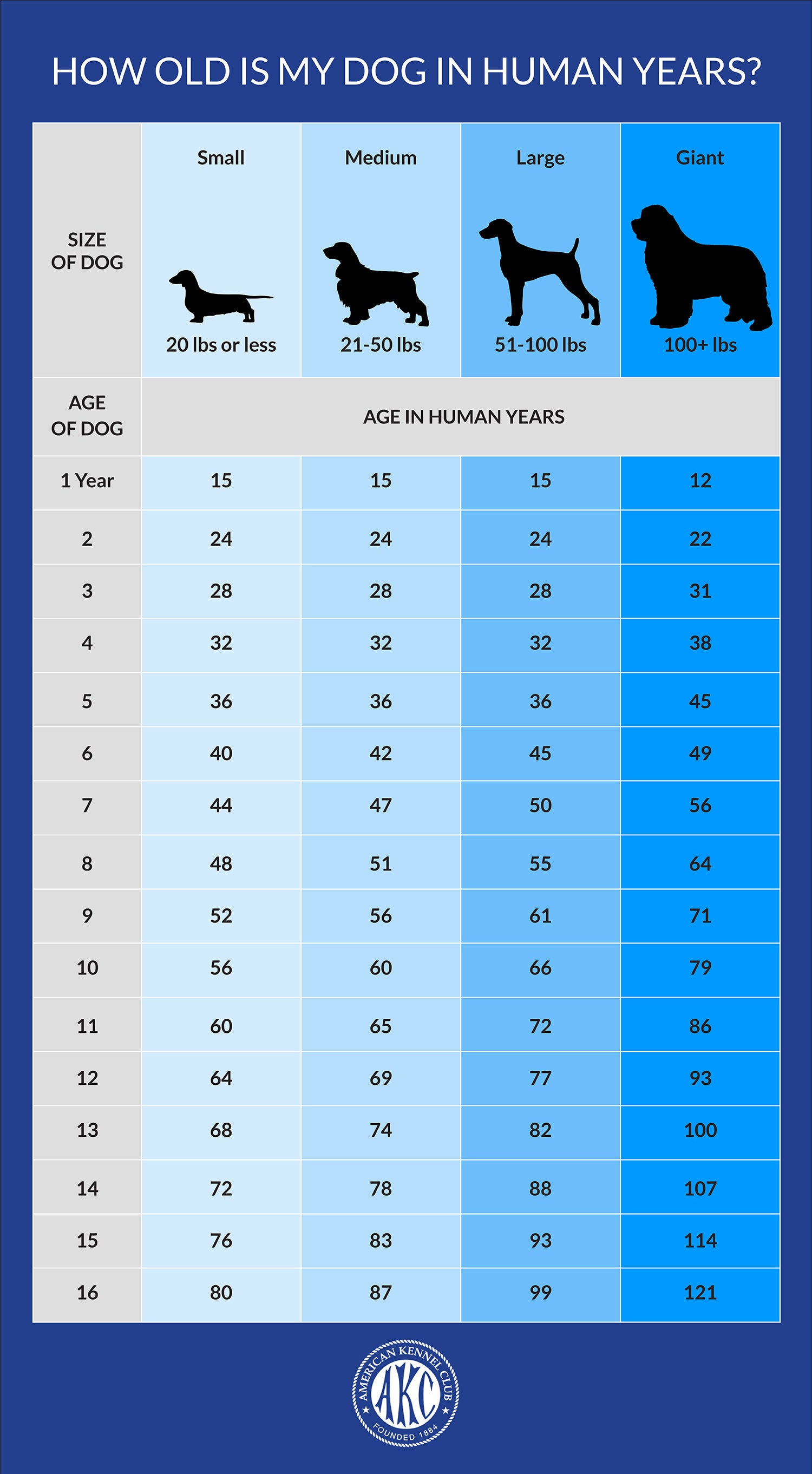
Explore puppy age in months. Human-age estimates are available from 12 months using the AKC chart; younger puppies are outside its published range.
Enter a valid age and select an adult size to see their estimate.
02 / THEIR AGE, IN PERSPECTIVE
Interpolated estimate1 year 6 months · Medium dog
THE BIGGER PICTURE
Dog age → human-equivalent age. The dot is your dog.
Months are interpolated between birthday milestones, using the adjacent values in the AKC chart.
Read the method and its limits →Source: AKC published age chart ↗. Monthly interpolation is our implementation.
THE FIRST TWO YEARS
Use calendar months, not four-week blocks. AKC chart values begin at 12 months. Values from 12 to 24 months below use the Medium column; Giant uses different values. Months below 12 are outside source coverage.
A calendar month varies in length. If you know their birthday, use the date option instead of dividing weeks by four. That avoids accumulating errors as your puppy grows.
The month values interpolate between birthdays. They do not measure biological development or determine when your puppy needs vaccinations, diet changes or other care. Ask your vet for an individual plan.
A HANDY LITTLE REFERENCE
Same birthday, different pace. See how adult size changes the estimate.
| Dog age | Small ≤ 20 lb | Medium > 20–50 lb | Large > 50–100 lb | Giant > 100 lb |
|---|---|---|---|---|
| 1 year | 15 | 15 | 15 | 12 |
| 2 years | 24 | 24 | 24 | 22 |
| 3 years | 28 | 28 | 28 | 31 |
| 5 years | 36 | 36 | 36 | 45 |
| 7 years | 44 | 47 | 50 | 56 |
| 10 years | 56 | 60 | 66 | 79 |
| 12 years | 64 | 69 | 77 | 93 |
| 15 years | 76 | 83 | 93 | 114 |
| 16 years | 80 | 87 | 99 | 121 |
Educational estimates. Weight boundaries are defined in pounds; kilograms are rounded for reference.
UNDERSTANDING THE EARLY MONTHS
This puppy age calculator compares a supplied calendar age with human-age values from the American Kennel Club’s dog age chart. The first published entry is at one year. For that reason, this tool provides human-age comparisons from twelve months onward and explains the source limitation for younger puppies.
A puppy’s real age remains the time since birth. A human-equivalent number is an educational comparison, not a measurement of development, readiness for an activity or health. The page includes the first twenty-four months so you can see both the available estimates and the months the source does not cover.
For eighteen months, enter 1 year and 6 months; for twenty-three months, enter 1 year and 11 months. Months must be whole numbers from zero to eleven. The default is an eighteen-month medium dog, which gives 19.5 human years. Reset restores this example, so replace it with your own puppy’s information before interpreting the result.
Choose “Use birthday instead” and enter your dog’s date of birth. The calculator counts completed anniversaries and the fraction of the current year through today. A future date produces an error. Birthday mode can differ slightly from entering rounded months because actual calendar intervals vary in length.
Select the weight category your puppy is expected to reach when fully grown. Current puppy weight can place a growing large dog in the wrong column. Optional breed suggestions provide a starting point; adjust size to suit your individual dog. Unknown or mixed breeds can use size directly without a breed name.
For Small, Medium and Large, the source values are 15 at twelve months and 24 at twenty-four months. Giant has different values: 12 and 22. We interpolate between those endpoints. The monthly values are our implementation of the chart, not monthly observations published by AKC.
H = L + ((months − 12) ÷ 12) × (U − L)
Here L is the first-birthday value and U is the second-birthday value for the selected size. Use this expression only from twelve through twenty-four months. Beyond the second birthday, the calculator uses the two surrounding entries in the full chart, whose yearly differences vary.
The original chart contains no values between birth and the first birthday. Dividing its first-year value into twelve equal pieces would introduce an unsupported assumption about early development. We therefore show a source-coverage message instead. A missing estimate means the reference does not cover the input; it does not mean your puppy’s age is invalid.
Eighteen months is halfway between the first two birthdays. The estimate is 15 + 0.5 × (24 − 15) = 19.5. Choosing Giant changes the endpoints and gives 12 + 0.5 × (22 − 12) = 17. Both examples use identical calendar ages; the selected source column explains the difference.
At exactly twelve months the calculator returns the first published value: 15 for Small, Medium and Large, or 12 for Giant. At twenty-four months the values are 24 and 22 respectively. These are direct chart lookups. At intermediate months, the badge changes to “Interpolated estimate.”
Neither age has a human-equivalent value in this source. Entering six months produces an explanation rather than a numerical preview. The manual form does not accept weeks. If the birth date is known, use it to avoid treating every calendar month as four weeks; the same source-coverage restriction still applies.
The result and curve update with your selected age and size. The month grid below the tool is a fixed Medium reference, explicitly labeled as such; it does not change when you choose another size. Its links open the matching month in the calculator. The separate comparison table shows all four sizes.
This puppy age calculator does not determine vaccination timing, feeding portions, exercise limits or physical maturity. It does not assign a clinical life stage or predict lifespan. Discuss care with a veterinarian who can assess the puppy’s breed, growth and health rather than basing a decision on a human-age number.
Copy result creates a summary of the current estimate. Share result creates a link containing your selected inputs, including the dog’s birthday if used. Birthday links recalculate on the day they are opened. Printing uses the browser’s print dialog. Unsupported ages disable these result actions because no numerical estimate is available.
No. It uses the age or birth date you supply. It cannot infer an unknown birthday from appearance, teeth or a photograph. When the starting age is an estimate, the converted age carries that uncertainty too.
The twenty-four-month grid is an age reference, not a definition of puppyhood for every dog. The tool does not use the page name or its chart endpoints to decide biological maturity. Its purpose is to make the source values and their limits easy to inspect.
The same calculator accepts supported ages up to sixteen. For a broader explanation, visit the dog age calculator or open the complete dog age chart. The breed directory helps select an adult-size starting point.
Research described by UC Davis compared DNA methylation in Labrador Retrievers and humans. Its equation, 16 × ln(dog age) + 31, uses the natural logarithm and measures a different relationship from the AKC size chart. It was not established as a universal formula for every breed.
Our optional comparison is limited to ages 1–16. It does not replace the main estimate or represent a DNA test of your dog.
Read the UC Davis explanation ↗Dog Age Calculator maintains this educational model. References provide context for age comparisons and life stages; their authors have not reviewed or endorsed this calculator. Birthday values come from the AKC graphic; our interpolation and boundary handling are disclosed above.
Method v2.0 · Updated · About Dog Age Calculator