A PRACTICAL GUIDE TO DOG YEARS
What is a dog age calculator?
A dog age calculator converts a dog’s calendar age into an approximate human-age equivalent. It helps answer “how old is my dog in human years?” with more context than a single fixed multiplier. Dog Age Calculator uses age and adult size to produce an estimate, show its calculation and place it on an age comparison chart.
The distinction matters: a five-year-old dog has lived five calendar years. A result of 36 human years describes an age comparison within our model; it does not change the dog’s actual birthday or measure their individual biological age. Two dogs with the same inputs receive the same estimate even when their health or behavior differs.
This free dog age converter is useful for exploring ages covered by the source chart, comparing small and large dogs, or checking a familiar dog-years claim. You can enter years and months, calculate from a birthday, or reverse the conversion. No account is needed, and the calculation runs in your browser.
How to use the dog age calculator
Start with Dog → Human. The default example is a five-year-old medium dog. Change the inputs to match your dog; the result, curve and table selection update together. The Calculate their age button also submits your current inputs.
Step 1: enter age in years and months
Use completed years in the Years field and remaining months in Months. For a dog aged eighteen months, enter 1 year and 6 months. The AKC chart begins at the first birthday; younger puppies receive a source-coverage message, not an invented human-age equivalent. The form accepts whole years and months, with months from 0 to 11 and a total age between 1 and 16 years.
Using the dog age calculator by birthday
Select “Use birthday instead” and enter the date of birth. The tool calculates age through today using calendar anniversaries, including the fraction of the current year. This dog birthday calculator mode avoids manually counting months. Future birthdays and dates beyond the supported age range produce an input message instead of a result.
Step 2: select fully grown size
Choose the weight category your dog belongs to as an adult. For puppies, use expected adult size, not their current weight. Breed search offers a starting category; you can change it. If your dog is mixed breed or their breed is unknown, leave the optional field blank and select size directly.
Step 3: read and check the preview
The large number is the human-age equivalent. Open “How did we get this number?” to see the arithmetic behind it. Try changing size while keeping age fixed to compare outcomes. Reset restores the original example; it does not preserve your previous inputs.
How to calculate dog years: the formula explained
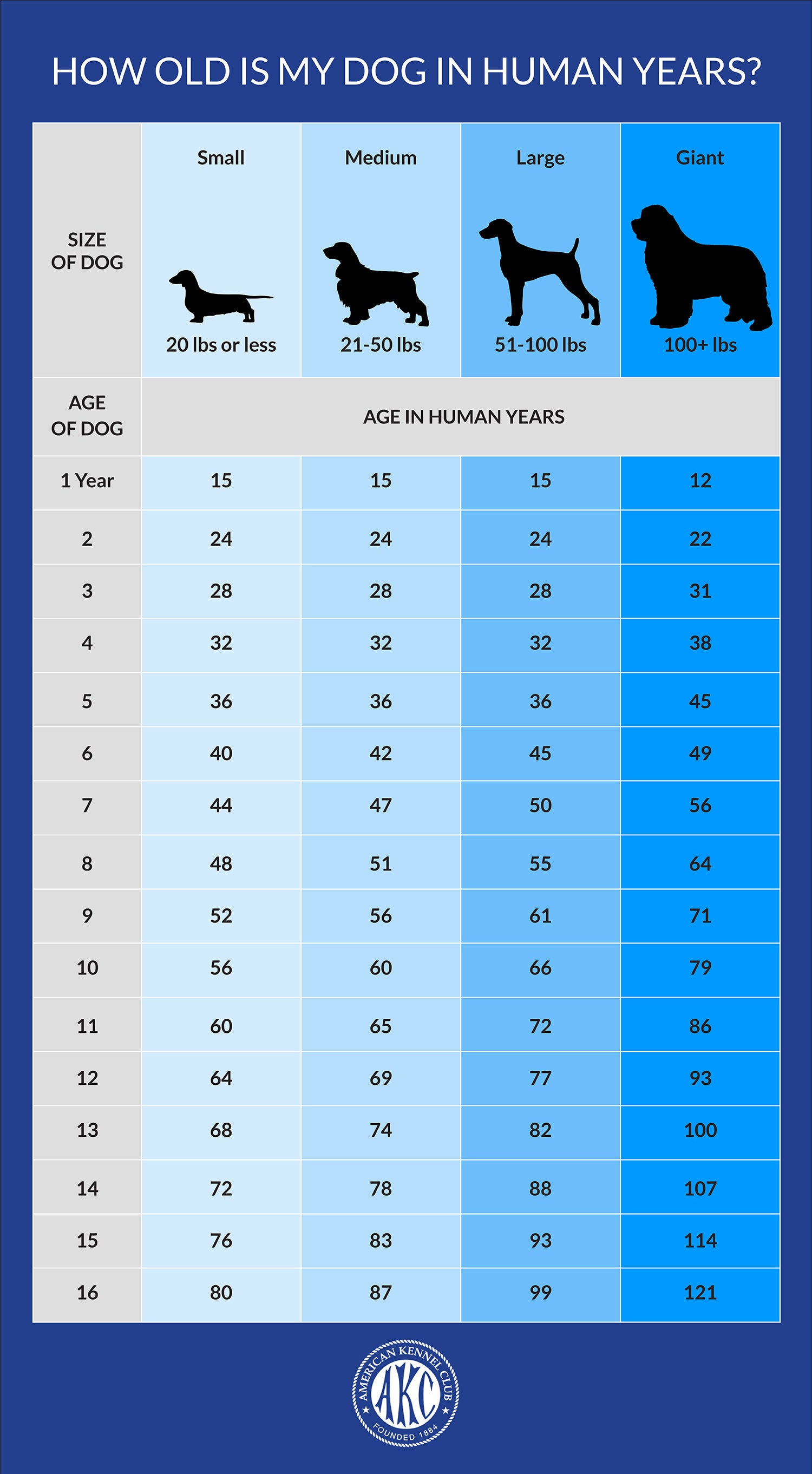
Our dog years to human years calculator uses the American Kennel Club’s published dog age chart. The chart provides sixteen birthday values for each of four adult sizes. We reproduce those reference values and connect adjacent birthdays with linear interpolation. Let a represent calendar age and H represent the human-age equivalent. For manual inputs, a = years + months ÷ 12.
Whole birthdays: look up the published value
At an exact birthday, the calculator returns the corresponding chart entry without applying an additional multiplier. At age one, Small, Medium and Large are 15; Giant is 12. At age two, the first three sizes are 24 and Giant is 22. This distinction matters when comparing young dogs across sizes.
Between birthdays: interpolate adjacent values
H = L + (a − n) × (U − L)
Here n is the completed birthday, L is its chart value and U is the next birthday’s value in the same size column. For a medium dog between five and six, L is 36 and U is 42. Halfway through that interval, the estimate is 39. Interpolation is our implementation choice; AKC’s graphic publishes whole-year values, not a validated equation for every month.
The supported range is one through sixteen
The source chart stops at sixteen and does not include ages below one. We do not extend it in either direction. Under-one puppies and ages over sixteen receive an explanation instead of a numerical conversion. This avoids presenting an unsupported extrapolation as a published reference. The range is a limit of this table, not a prediction of how long a dog can live.
Why not multiply dog years by seven?
A fixed multiplier gives seven human years at the first birthday; the AKC chart gives fifteen for three size groups and twelve for Giant. The chart also changes its year-to-year increments with age and size. The familiar “15 for year one, nine for year two, then roughly five” rule is a broad description and does not reproduce every cell in the AKC table. Our calculator specifically follows the table.
Dog years to human years: worked examples
These examples use the exact model above. The links open the matching inputs, so you can reproduce each answer and change one setting at a time.
A puppy age calculator in months
For an eighteen-month medium dog, a = 1 + 6 ÷ 12 = 1.5. The adjacent birthday values are 15 and 24, so 15 + 0.5 × (24 − 15) = 19.5 human years. For a giant dog, the same calculation uses 12 and 22, giving 17. Both are interpolated comparisons rather than developmental assessments.
Try the eighteen-month example, or explore the puppy age calculator. A six-month-old puppy has no numerical equivalent in this source chart.
A five-year-old medium dog
Enter 5 years, 0 months and Medium. The published chart entry is 36 human years. Add six months: the next birthday’s entry is 42, so 36 + 0.5 × (42 − 36) = 39. For a large dog, the six-year entry is 45, so five years and six months gives 40.5 instead.
Try five years and six months and compare Medium with Large while keeping the age unchanged.
The same birthday, four different sizes
| Adult size | Age five | Age ten |
|---|---|---|
| Small | 36 | 56 |
| Medium | 36 | 60 |
| Large | 36 | 66 |
| Giant | 45 | 79 |
Some sizes share a value at a particular birthday; their later values need not match. A ten-year-old small dog maps to 56, whereas a giant dog maps to 79. These are comparisons within a broad reference chart, not individual measurements of health.
Dog age calculator by breed, size and weight
A breed name can help you choose an adult-size category, but it does not unlock a separate formula. Our dog age calculator by breed uses the same four chart columns for every listed breed. A Labrador Retriever or Golden Retriever suggests Large; a Chihuahua suggests Small. You can override the suggestion for your individual dog.
Small, medium, large and giant dogs
The small dog age calculator category covers adult weights up to 20 lb; Medium covers over 20 through 50 lb. The large dog age calculator category covers over 50 through 100 lb, and Giant covers more than 100 lb. A dog at exactly 20, 50 or 100 lb belongs to the lower category at that boundary.
Pounds, kilograms and category boundaries
Kilogram labels are rounded references: approximately 9.1, 22.7 and 45.4 kg at the boundaries. The original graphic labels Large as 51–100 lb and Giant as 100+ lb, creating an overlap at 100. To make selection unambiguous, this tool assigns exactly 100 lb to Large and weights above 100 to Giant. Fractional weights above 20 or 50 enter the next category. This is a category model, so crossing a boundary selects a different chart column. Real aging does not abruptly change at that weight. Use an appropriate adult-size category rather than treating temporary weight changes as changes in age.
Mixed breeds and unknown breeds
A mixed breed dog age calculator does not require a pedigree. Choose the relevant adult size and leave breed empty. The breed guide lists the available suggestions and provides links back to the tool. For a puppy whose adult size is uncertain, compare plausible categories and treat the difference as model uncertainty.
Human years to dog years calculator
Select Human → Dog and enter a human-equivalent age. This human to dog years converter finds the surrounding entries in your selected size column and solves the same linear segment in reverse. It answers a mathematical comparison question; it does not estimate a dog’s unknown birthday from physical characteristics.
Example: what dog age equals 60 human years?
For Medium, the published ten-year entry is 60, so the reverse result is exactly 10 dog years. For Large, 60 lies between 55 at eight and 61 at nine: 8 + (60 − 55) ÷ (61 − 55) ≈ 8.83 years, approximately eight years and ten months. Open the large-dog reverse example.
Reverse formula and input limits
Between adjacent chart entries use a = n + (H − L) ÷ (U − L). Accepted human-equivalent ranges are 15–80 for Small, 15–87 for Medium, 15–99 for Large and 12–121 for Giant. These correspond to dog ages one through sixteen. Changing size can make a previously valid number fall outside the new column’s range; the tool then asks for a supported value.
How to read your dog age calculator results
Human-age estimate, curve and age chart
The approximation symbol means the displayed number is an estimate. Decimals are rounded for readability. The curve places your selected age along the size-specific conversion; the dog years to human years chart compares all four sizes at common ages. Expand the homepage table to show all ages one through sixteen, or download the chart as a CSV file.
What the method badge means
“Chart reference” identifies an exact birthday entry. “Interpolated estimate” identifies a value calculated between two published entries. The explanatory card and calculation details show which kind of result you are reading. We do not assign Puppy, Adult or Senior clinical stages from arbitrary age thresholds.
AAHA describes life stage using age and individual characteristics. A human-age equivalent alone cannot determine appropriate care. This tool does not assess symptoms, diagnose conditions or estimate remaining life. A veterinarian can interpret your dog’s age alongside their health and circumstances.
Copy, share or print a result
Copy result creates a text summary. Share result creates a link containing the selected inputs; anyone receiving it can read those inputs. A birthday-based link recalculates through the day it is opened, so its result can change over time. Print opens your browser’s print dialog. Download chart exports reference values rather than a medical record.
Dog age conversion questions
How old is my dog if I do not know their birthday?
Enter your best estimate in years and months. This tool converts a supplied age; it cannot discover an unknown age from a photo, appearance or behavior. An estimated starting age produces an estimated result, so avoid interpreting the displayed decimal as extra certainty.
How old is a two-year-old dog in human years?
In this model, a two-year-old dog is 24 human years for Small, Medium and Large, and 22 for Giant in the AKC chart. Always choose size before interpreting a value.
How old is a seven-year-old dog in human years?
The estimates are 44 for Small, 47 for Medium, 50 for Large and 56 for Giant. These are direct entries from the published seven-year row. Choose your dog’s adult size before interpreting a single answer.
Is this dog age calculator accurate for every breed?
It is consistent with its stated approximation, but it cannot measure every individual dog’s aging. Breed suggestions select size only. Other dog years converters may use different charts, breed assumptions or research models, so disagreement does not necessarily indicate an arithmetic error.
Can I calculate puppy age in weeks?
The manual fields accept years and months, not weeks. If you know the birthday, use date mode for a calendar-based calculation. Do not assume four weeks equals one calendar month. The source has no under-one human-age values; the puppy calculator explains the month-based view.